ABC’s Big Ideas has released the Boys Don’t Cry program online for viewing.
The televised version is shorter by about 20 minutes and doesn’t include my speech at the end of the forum. The online long version does. I invite you to watch is however please be aware that some of the program is fairly confronting including what I have to say at the end.
Long version of the Boys Don’t Cry segment
Big Ideas Boys Don’t Cry segment
On Wednesday evening, 20 November 2013, I attended a panel discussion at the Australian War Memorial on Post Traumatic Stress Disorder. The event was hosted by journalist/writer Paul Barclay on behalf of ABC TV and Radio National.
On the panel were former Chief of Army LTGEN Peter Leahy; author and Beyond Blue ambassador Allan Sparkes; Beyond Blue board member Professor Brett McDermott; and the wife of a former British Royal Marine, Emily.
I was asked about attending the panel a few days earlier by my friend Jason. Originally I didn’t want to attend as I honestly thought it may be a trigger for an anxiety episode; so I declined. It wasn’t until the night before that I decided to go along and hopefully have a chance to speak to whoever was on the panel. I had no idea who was participating in the discussion other than LTGEN Peter Leahy and hadn’t really thought about what was going to be discussed.
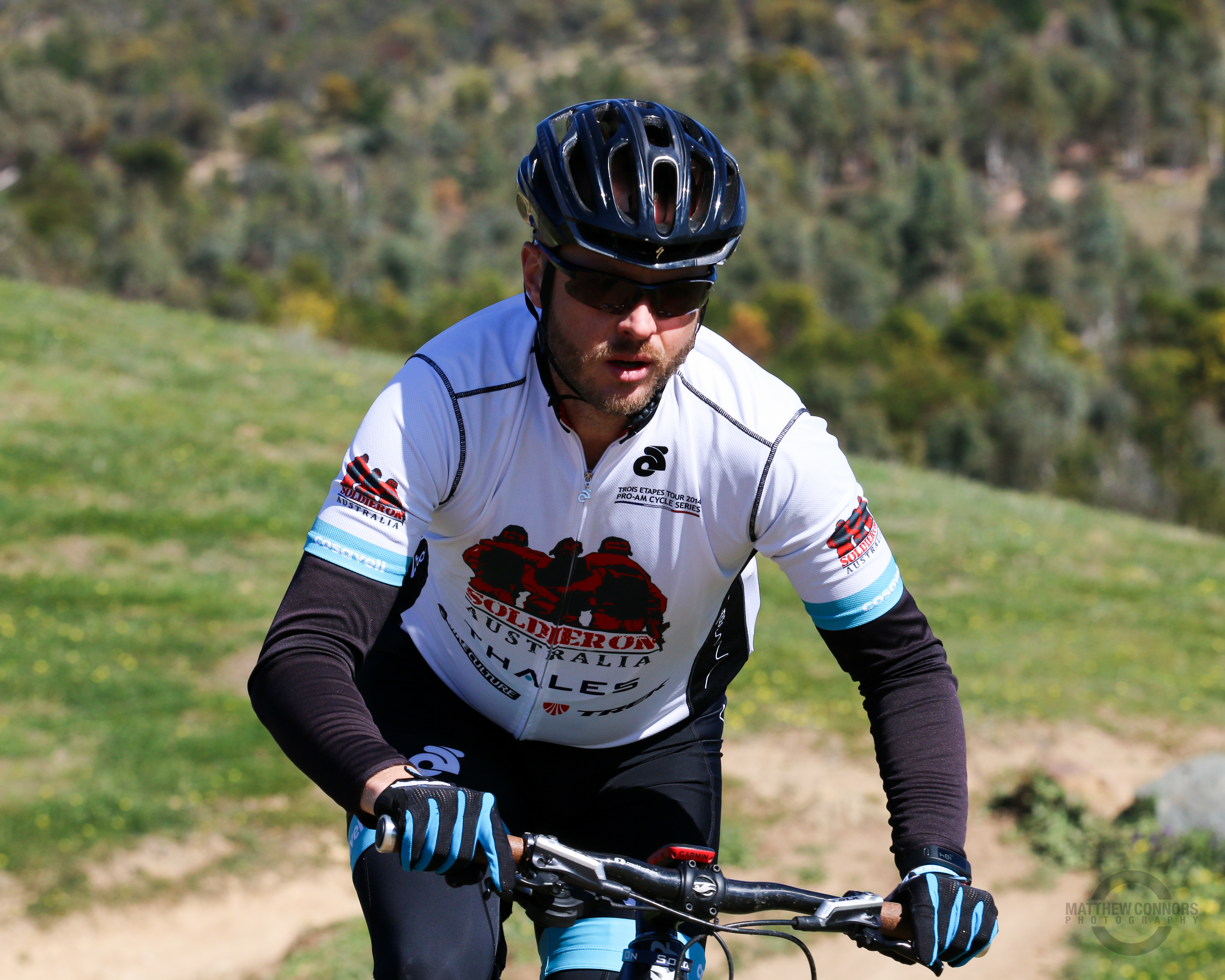
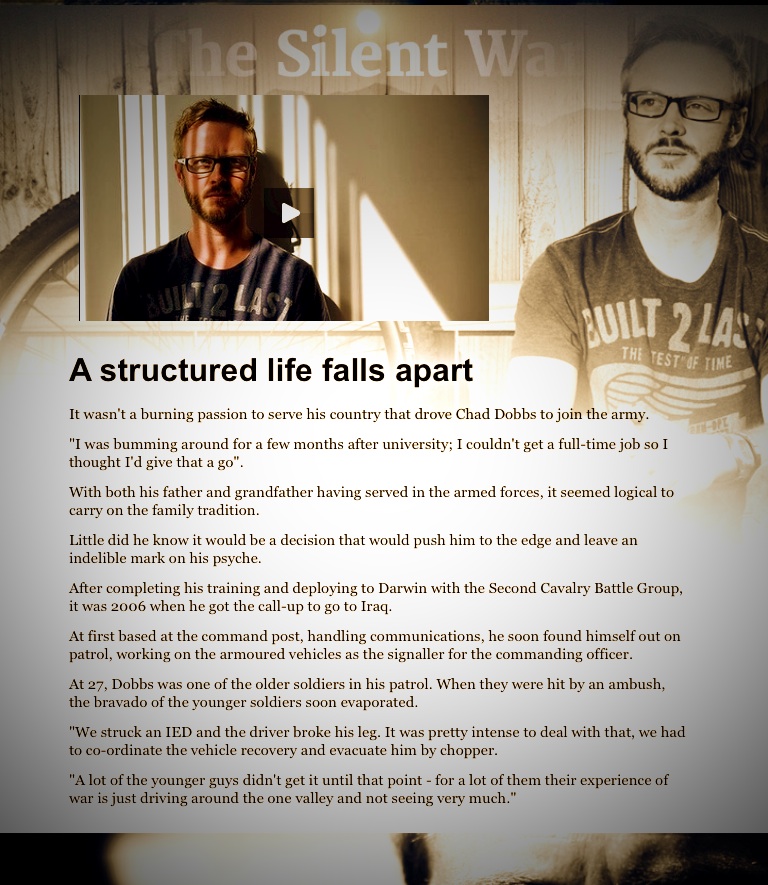
In the afternoon prior to the start of the forum, I rode from work up to the Australian War Memorial. As is the norm, I was wearing my Soldier On jersey and happened upon new Soldier On team member Tony; who many moons ago was my Troop Commander when I served in Iraq. Jason arrived next and soon we were joined by Anna, Meredith and Dion from Soldier On. After I got changed into something more appropriate than skin tight lycra, we went into the BAE Systems Theatre.
After the introductions Paul started the discussion with some questions about PTSD in the military for LTGEN Leahy. The conversation and questions started to flow freely within the panel with some very emotional stories being shared by Emily and Allan. Prof McDermott gave some very interesting insights on PTSD for not only military personnel; but also for emergency service persons and of course their families.
I wasn’t the only veteran in the crowd; but I was the youngest. There were a few Vietnam Veterans present, family members of veterans with PTSD and a few senior Defence officers that were skulking around the back pews in civilian attire.
As the discussion progressed LTGEN Leahy was asked some questions about support services available to veterans. I have a lot of respect for this man; he was an exceptional Chief of Army and has done a lot to help veterans with his current position as Chairman for Soldier On. But there is a distinct level of detachment from what a high ranking officer is told and what happens on the ground.
Some of his responses started to irk not only me, but a lot of the crowd listening to him. There were more than a few audible scoffs at some comments about the Department of Veterans affairs doing their best to help all veterans. One comment in particular drew a very audible “get fucked” from me. The former Chief of Army said that when a Soldier asks for help, he or she will always receive it. Paul mentioned the story of MAJGEN John Cantwell and LTGEN Leahy was in agreement. Whilst MAJGEN Cantwell has done a lot to help break the stigma of PTSD in the ADF; it is also true that a very senior Officer is never going to be turned away when they ask for assistance.
Allan Sparkes shared his story of PTSD and depression from when he was a Police officer; and the ostracising that he experienced as a result. His story was a very raw, no punches pulled recount of his darkest days and his termination from his employment without his knowledge. His story was very reminiscent of many veterans from the Vietnam War up until today’s conflicts.
Emily’s story was one of amazing courage from both her and her husband Adrian. She spoke of her time in the United Kingdom when Adrian returned from deployment in Afghanistan a changed man. He had experienced traumatic events and as a result developed PTSD. His struggles with mental health affected his wife and two daughters as they watched as their husband and father dealt with his issues now that he was back at home. His eventual discharge from the Royal Marines was a result of a physical injury and just like the majority of occupationally injured Australian servicepersons; Adrian was soon pushed out the door with very little support and preparedness for his transition to civilian life.
As the forum was drawing to a close Paul invited Dr Brendan Nelson, director of the Australian War Memorial to speak and field some questions from the panel. He spoke about the AWM’s role with supporting veterans of recent conflicts by having interactive exhibits and involving them with other projects the AWM is conducting. As a former Minister for Defence he expressed his desire to see more support forthcoming as the Afghanistan War draws to a close.
As 7pm was quickly approaching a few of us in the audience were wondering if we would get a chance to ask questions of the panel. Adrian was next to take the stage and he recounted some of his experiences post deployment and how support for veterans is extremely slow from the government in Britain. He spoke of having his claim for assistance being rejected on the first submission; a trend very similar to that in Australia carried out by DVA.
Adrian expressed his concern for veterans being forgotten after the withdrawal from the Middle East and a strong desire for them to be able to access the support they deserve and not repeat the mistakes of the past. He likened the struggles of today’s returned servicepersons to that of the Vietnam War era in the way that the fight for support continues even after the war on foreign soil has ended.
Adrian’s address to the panel and audience had clearly reached out to everyone with many of the Vietnam Veterans visibly moved by his honesty. As he sat down Paul checked his watch and asked us sitting in the audience if anyone had anything questions or comments. I had been sitting and fidgeting for the past 10 minutes waiting for this moment. Several different introductions and talking points had gone through my head and all disappeared in the instant I raised my hand and Paul motioned for me to stand up.
I was shaking before I even started speaking; this was always going to be an emotionally charged interaction from me and I started by introducing myself.
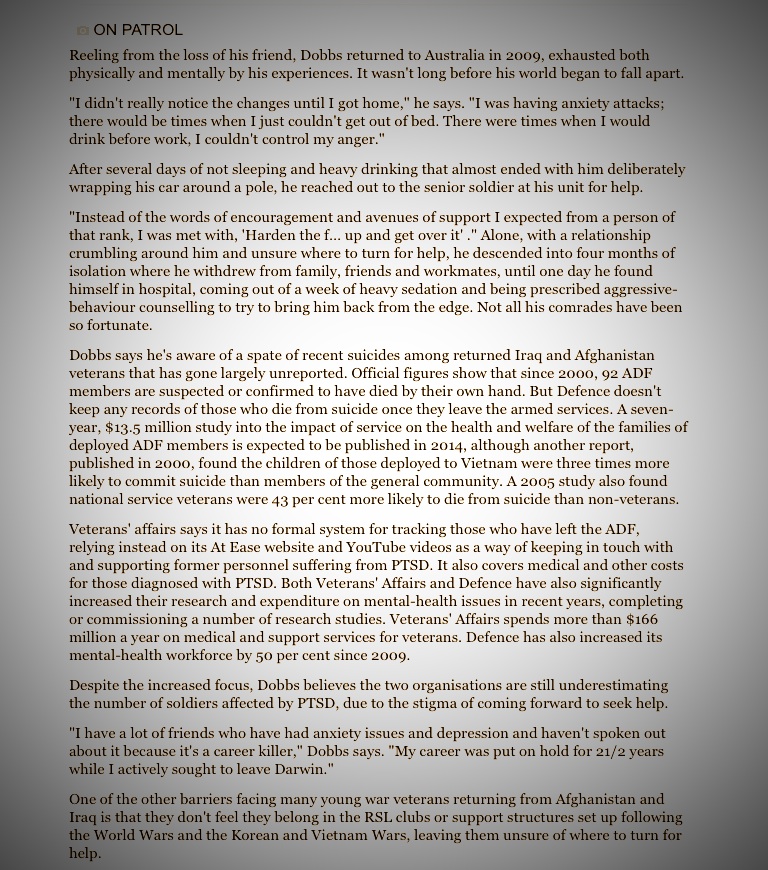
“Hi I’m Chad, I separated from the Army early last year and have deployed to both Iraq and Afghanistan. I have been diagnosed with PTSD, depression and anxiety and I want to know why not enough is being done to help Australian veterans.”
I addressed LTGEN Leahy first and exclaimed to him that history was indeed repeating itself.
“I am a third generation Soldier, my Grandfather served in World War 2, my Father served in Vietnam and I have served in the Middle East. I watch as my Father and his mates still struggle with PTSD with many Vietnam Veterans taking their own lives since the war ended. I watch as my generation struggles with the same issues and now my mates, people I served with, are killing themselves because of PTSD and depression; and nothing is being done to stop this. There are more people in the ground because of PTSD and depression than there are that are on the wall outside who were killed on operations.”
I spoke of my efforts to get help when the weight was becoming too much for me to bear and that the first two times I asked for assistance I was rebuffed by my unit RSM’s; a statement that clearly shocked LTGEN Leahy. I was asked questions from both Allan Sparkes and Prof McDermott about my interactions with DVA and I recounted how I was told that my claim was going to be slow as my PTSD and depression ‘wasn’t that bad’. I explained to them that is was at this point that I withdrew my claim and stopped interacting with DVA as I felt I was being accused of chasing money and that by not receiving financial assistance my criticism of their practices would hold more weight in a public forum.
I described my battles with depression and that very few people understood; and the simple act of asking for help effectively stalled my career in the Australian Army for a number of years. The feeling of being ostracised and singled out was always present and that few people would support me when I asked for further help. I explained that while MAGJEN Cantwell’s story is not an isolated one, the level of support and assistance he received was. The average Digger in a unit has to contend with the ever present stigma of mental health issues and ignorance present within their chain of command and the probable persecution for not being able to fulfil their duties without restrictions.
I expressed astonishment that the very organisation founded to protect the rights of and provide assistance to veterans was failing in its primary role. I emphatically asked how in the forty years since the end of the Vietnam War servicepersons are still not being afforded the support we fought for. How it was possible that DVA can state they are still learning and getting better with a straight face as veterans from multiple deployments and generations kill themselves while waiting to access support services.
By this stage the room was silent and I had been speaking for around 20 minutes. The panel while sometimes asking me questions and making statements had clearly been unprepared for such a raw and uncompromising speech from someone. I had brought up some points with personal accounts of systematic failures from within the Australian Army, Australian Defence Force and the Department of Veterans Affairs.
There were some topics that I shared with a public forum that had only been discussed with medical professionals and not even shared with my wife and family. As my speech drew to a close I expressed the hope that one day veterans would receive the appropriate support from the Government but that it was very unlikely to occur in my lifetime and that my children probably wouldn’t see it happen either.
As I finished speaking I apologised for hijacking the Q&A session; Paul started wrapping up the forum and I sat down nervously. Jason patted me on the shoulder and most of the audience was either nodding in agreement or wiping away tears. I sat shaking and started to feel quiet anxious from speaking to a mostly unknown audience about issues so personal and distressing that I had spent the last few years repressing and ignoring them.
The rest of the evening was spent talking with members of the audience and panel. I received a great number of business cards and offers of assistance and opportunities to speak to other veterans and people with PTSD and depression. I found the response surprising and was shocked when LTGEN Leahy approached me as he was leaving. He handed me his business card and told me to email him. He offered to take me to see the Minister of Veterans Affairs to discuss the issues I had brought up.
He told me that the Service Chiefs would be made aware of what I had spoken about and that I should continue speaking up. Both he and Dr Nelson expressed the need for younger veterans to be the public faces and voices of our generation and that I should be one of them. I was very humbled by this statement and thought a lot about it over the following days.
At the conclusion of a big night, I farewelled Jason and the Soldier On crew, thanked the others and started riding my bike back home. The next 45 minutes were some of the most contemplative times of my life as I thought about what I had said and the inevitable shock-waves that they would create for my family and I when the ABC airs Boys Don’t Cry on Big Ideas in late 2013/early 2014.



















 Blogged Down By Life