Why I Ride For Soldier On

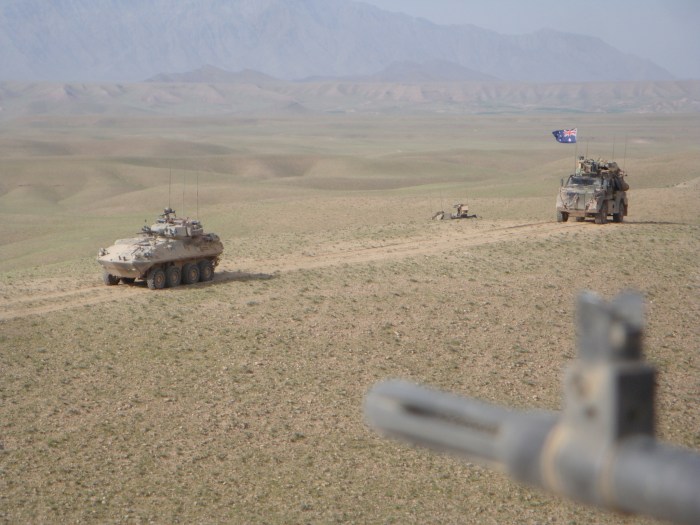
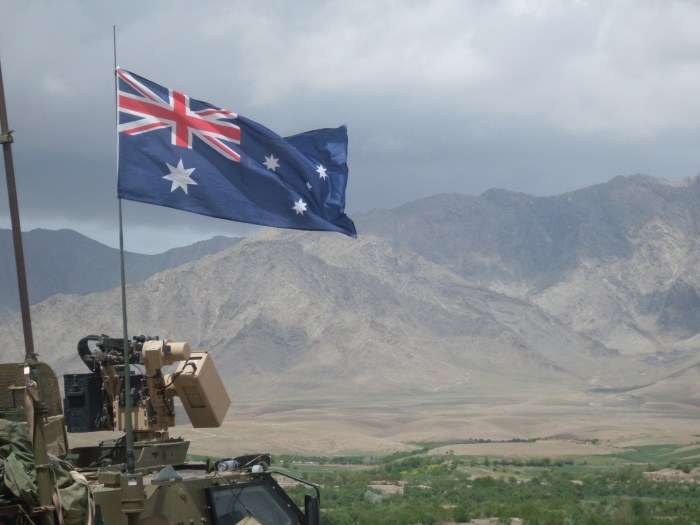
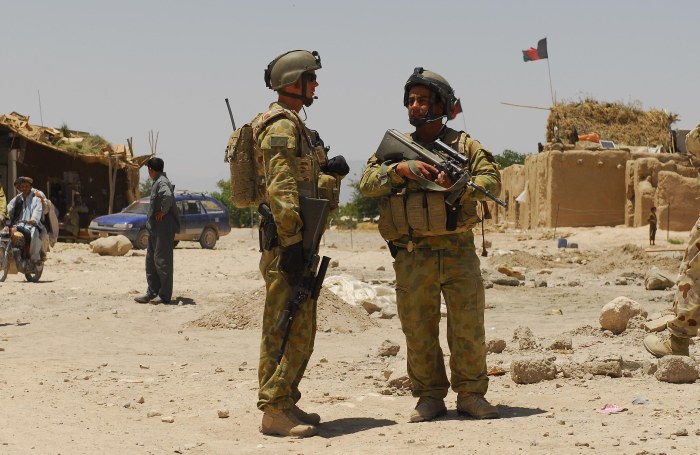
During my time in the Australian Army I served in both Iraq and Afghanistan. In 2009 after returning from 9 1/2 months in Afghanistan I knew something wasn’t right. I was aggressive to most people, wary of crowds, couldn’t sleep, had sleeping issues and started drinking heavily. Like most Soldiers, I didn’t want to talk about my issues in case I was seen as being weak and God knows there were others that were worse off than me. So I kept quiet and not surprisingly, things got worse. I didn’t want to spend time with other people and I started thinking this world would be better off without me.

After several days of no sleep, heavy drinking and almost wrapping my car around a pole on purpose, I approached and asked the Senior Soldier at my unit for assistance. Instead of the words of encouragement and avenues of support I expected from a person of that rank, I was met with “harden the f*** up and get over it”. In that one moment I felt defeated, I was dismissed by the one person who is solely responsible for the welfare of the Soldiers subordinate to them. If this person wouldn’t help me and I could no longer help myself then what was next?

Luckily for me I posted into a new unit and found the support I so desperately needed from my new workmates. After a while I finally found the courage to tell my family I needed help. Road blocks were set up by another Senior Soldier and my desperation grew greater until I hit rock bottom; I attempted to end my own life. It was only when my life was at its darkest did professional help eventually appear; it was provided by a civilian agency and organised by a very kind Navy doctor.

With only the bare-minimum of support coming from within the ADF I relied heavily on my family and friends for the ongoing support I needed. After having all support services cut off after I left the Army and the near-impossibility to secure an appointment to see a DVA accredited councillor; I started talking about my issues with others and realised that many other Soldiers had been experiencing the same obstacles; especially those that had separated from the ADF.

This is the reason I am so passionate about the provision of mental health care for returned veterans. The system is not yet good enough and so we rely on each other to be open and honest for ongoing support.

Soldier On helps by providing something other support services do not. They provide hope, confidence and a hand up – not a hand out.

Battle Of The Beasts – Update #3

Well it’s been a big week for my fundraising. After a disappointing few weeks with trying to get more exposure for the upcoming ride I had some promising leads with securing some local media interviews for radio (thank you Jeff C!) and a couple of Canberra’s newspapers.

The donations have been steady, but the Facebook ‘sharing’ and Twitter ‘retweets’ have been very active; which helps raise awareness for Soldier On. I even managed to set up a Facebook Page: Riding For Soldier On – Doing My Part For Australia’s Wounded Warriors to help keep my Facebook friends and Twitter followers up to date.

From a training perspective I’ve spent a fair bit of time on the bike and should top 200km by the end of the week. I’m not quite 100% with my pec and shoulder but from a fitness and endurance perspective I am pretty close to being at my pre-injury standard. And most importantly, after a taking a pretty big confidence hit courtesy of an overzealous Government Department; I’m feeling better and determined to work just as hard and keep rocking the apple cart.

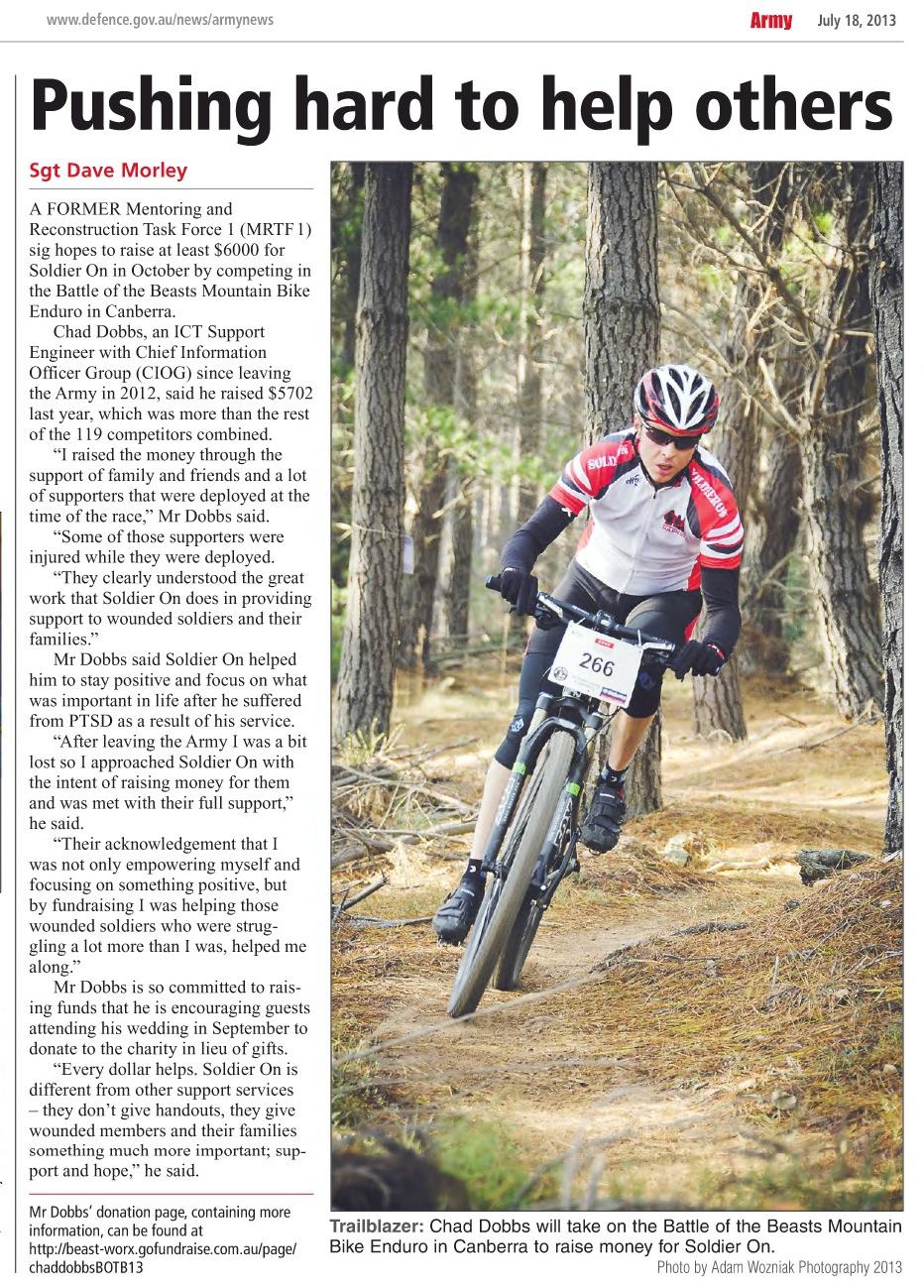
During the week I had an article about my fundraising published in the Australian Army News. This is great for exposure within the ADF and Australian Army in particular and will hopefully be noticed by some of the Senior Ranks. Maybe they will start to realise that a handful of dedicated individuals (mostly ex-Soldiers living with PTSD) do more work for Veterans Support Services and PTSD education than they do sitting in their ivory towers dismissing mental health issues among the ‘enlisted men’ </END RANT>.

Army News Jpeg
$1’815 has been raised so far and with three months to go there is plenty of time to better last years amount.

PLEASE GO HERE TO DONATE: http://beast-worx.gofundraise.com.au/page/chaddobbsBOTB13

Riding For Soldier On – Australian Army News

A short article about my fundraising for Soldier On for this year’s upcoming Battle Of The Beasts Mountain Bike Enduro has been published in the 18 July 2013 issue of the Australian Army News.

Army News Jpeg

Army News Article PDF Version

18 July 2013 Army News Edition 1309 PDF Version

Training Week In Review – Week 3

Week 3 started off well.  I commuted to and from work on Monday; the short way and shortish way respectively.  Tuesday saw an early start at work and the need for me to drive in.  I put the XTC in the back of the car in the hope I’d be able to hit the trails after work.  Thanks to be oh-dark-hundred start I made my way out to Sparrow Hill for some quick fun on the immaculate trails.

I cheated on Wednesday and put the roadie in the back of the girly’s car for a quick commute home.  The ride itself was fairly standard except for the now infamous bike pump versus car bumper incident.

Thursday I strapped on the Shimano MTB shoes and took Kate in with the intention of taking her for a spin around Bruce Ridge on the way home.  The weather was a bit ordinary with 80km/hr wind-gusts that tried their best to knock me off the bike and into Lake Burley Griffin.  So I rode home via Belconnen and around Lake Ginninderra.

Friday was meant to be a medium length ride around Kowen Forest and Sparrow Hill on my Giant Anthem Zooey.  But alas it was not meant to be thanks to a single phone call.

Saturday was a rest day/bike maintenance day spent preparing my XTC for Sunday’s CORC XC Race.  I replaced the standard Shimano rear derailleur in favour of a Shimano XT Shadow to reduce the annoying chain slap.  This didn’t quite go to plan and I was left with about four non-slipping gears for the race the next day.

I wasn’t feeling the best before this race.  My heart wasn’t in it and my head definitely wasn’t.  I woke up early and decided I’d give it a go.  I’m glad I did.  I managed to pull in fifth place and pushed myself further than I had before on a short course race.  I went out fairly easy at the start and picked up the pace quite considerably for the second lap finishing almost 3 minutes faster than my first.

At the end of the race I was 149.9km for the week… 100m short of my 150km target.  So after my shower I took out my single speed flat bar and rode a quick 500m to reach my 150km goal.  At the end of Week 3, I had some ups, plenty of downs and one hell of a good time at Kowen Forest racing.

CORC XC Rd 3 #02 CORC XC Rd 3 #01

Standing In The Shadow Of The Green Giant

As more and more returned veterans put their hands up and ask for help the processes for support services are steadily improving.  Thanks to people like MAJGEN John Cantwell the stigma that is attached to persons with PTSD is slowly disappearing.  It takes a lot of courage to speak openly and honestly about an issue that often results in self-harm, substance abuse and even suicide.  For a high-ranking, high-profile ADF member to stand up and acknowledge that his service to his country has caused a mental illness is incredibly brave.  By shedding his uniform, rank, and medals; John Cantwell has empowered other returned veterans to admit that they too need assistance.

Recognising that there is an issue is the first of many steps towards recovery and rehabilitation.  The second step is often the most difficult and at times the point where a person in uniform will retreat and hide; raising your hand and asking for help.

The Australian Defence Force and Australian Army in particular are constantly in the media tackling varies issues such as sexual misconduct and gender equality.  While both are extremely important in their own regard, the spotlight rarely shines on another equally important issue; the culture towards members with PTSD and depression.

I’m not going to pretend I know about every single ADF member’s details about living with mental illness.  I know about my own experience and also others that were brave enough to share their stories with me.  I struggled for months before I put my hand up and asked for help.  As I’ve stated before I was rebuffed by the one person at my unit whose primary duty it is to look after Soldier’s welfare.  Being told to “Harden the fuck up” struck a huge blow to my confidence and I started to withdraw from those around me.

Others have related the same kind of experiences to me with regards to their first encounters within the chain-of-command.  Some superiors ridiculed and some provided that much needed assistance.  It took several months for me to ask for assistance again.  Many around me were extremely supportive; there were a small group of supporters from the Army that fought tooth and nail to get me the help I desperately needed.  But there were others that seemed determined to prove that what I was living with was my fault and I should get over it. 

There were words spoken to me in private while I was at my lowest point which were delivered with such venom a day rarely goes by that I don’t hear his words in my head.  “You are a fucking lying soft cunt”.  These words were delivered at me as I lay in a hospital bed awaiting the arrival of my parents from interstate.  I had suffered an anxiety episode so severe I admitted myself to an Army hospital.  This would also be the moment where others further up in my chain-of-command became aware of what was happening and after almost 12 months of living with PTSD, anxiety and depression I was finally able to acknowledge I couldn’t continue without help.

While my story is not uncommon it is certainly not the norm.  Many ADF members ask for help and are looked after very well with counselling, rehabilitation services and flexible working arrangements.  One of the first things that occur once an ADF member seeks professional help for depression, anxiety or PTSD is the implementation of restrictions on their terms of service.  You are no longer allowed to do certain tasks that are deemed to be dangerous to yourself or others and your career and posting options are effectively stalled.  While many of these restrictions are incredibly important and beneficial, such as no access to weapons or limited field time, others such as removal from your normal job into an administrative role often causes more undue stress.

I had several restrictions placed upon me when I was posted to Brisbane.  No access to weapons, security clearance review, no promotion courses, regular drug testing, six month alcohol ban, weekly performance reviews, fortnightly counselling sessions and no field exercises among others.  At the time of my new posting I was incredibly fatigued, I was 10kg under my ‘ideal’ weight, insomnia plagued me, anxiety attacks were the norm and of course I was acutely depressed.  My new unit; in particular my Troop Commander and Troop Sergeant were incredibly supportive; and as I got to know the rest of the Squadron members I was able to continue my rehabilitation with very few interruptions.

My life was well and truly back on track and my symptoms had abated.  I had met and started a relationship with my future wife and I was enjoying the availability of time to spend with my family; in particular my Twin nieces.  But as with all things in the Army, resources were stretched thin and when my restrictions of service expired I was called upon to step up and take on extra responsibility.  I relished the opportunity to prove my worth and performed some very big tasks with very limited resources and manning.

When the time for the new posting cycle to be reviewed came about I was bounced back and forth between a heavily constrained Career Management cell and a senior Soldier that should never have been allowed to look after Soldier’s welfare and career issues.  In the end my career plan was completely discarded and the aspirations of another Soldier were forwarded to my Career Manager instead.  During this incredibly stressful period I spent the majority of April to August on exercise in Northern Queensland with very little consultation on my next posting.  By the time I was actually consulted about what locality I may have wanted I was given one option; Kapooka, home of the Army Recruit Training Centre.  It was decided that I was to become a Recruit Instructor.

During this time I was having depressive episodes and anxiety attacks.  However instead of shying away from the issues that were causing this; I tackled them head on.  I solicited the advise of family, friends and colleagues on the pros and cons of taking this unwanted posting or leaving the Army; my only two options.  Just as many people advised I accept the posting as those they suggested I discharge and find a new job.

Finally I gained employment outside of the Army and started my separation process.  This is usually a long and drawn out process, however as it was nearing the end of the year and I had to move interstate; my paperwork was rushed through the system.  My unit was incredibly helpful during this stage with many of my in-trade superiors expressing that I had made the right decision and that “The Army had changed”.  It was true; I no longer felt like an individual Soldier, instead I felt like a number that was being shuffled around a giant spreadsheet.

I left the Army without a farewell, without a discharge certificate being presented and without any ongoing assistance for my depression and anxiety.  Months later, after I was settled into my new home and job, did I start realising I was relapsing; I was missing my friends and previous life.

Without the support of the ADF I relied heavily on my family and friends for the ongoing support I needed.  I did reach out to the Department of Veterans Affairs after the death of my Grandfather and was placed on a six-week waiting list to see a councillor.  Two days before my appointment I was advised it had been cancelled and my rescheduled date was another four weeks away; I never turned up to it.  Instead I started talking about my issues with others and realised that many other Soldiers had been experiencing the same obstacles as me especially those that had separated from the ADF.

This is the reason I’m so passionate about the mental health of returned veterans.  The system is not yet good enough and so we rely on each other to be open and honest for ongoing support.  The Australian Army was built on courage and mateship.  Those that speak up about their battles with mental health issues and the lack of ongoing and adequate support services are continuing that tradition even if they no longer wear the uniform.
Battle Of The Beasts – Update #1

Well I’ve been a little slack in keeping everyone up to date with my fundraising and training for the Battle Of The Beasts in October.

However, I haven’t been slack in my fundraising and other efforts in raising awareness for Veteran’s Support Services.  I have contacted numerous local businesses requesting support and sponsorship for my fundraising and have had a few promising leads and some disappointing rejections.

Being an ex-Soldier and current Defence employee I contacted a few of the larger companies that are contracted to provide services to the Department of Defence.  My thinking was that these companies would be willing to spare a few dollars from the hundreds of millions Defence pays them to support an ex-serviceman raise some money for wounded Veterans and their families.

Well, shit! How wrong was I!  I won’t name and shame them (yet!) but I received a couple of abrupt rejections and one very sarcastic and disrespectful reply to my very reasonable request for support.  I took it with a grain of salt and contacted the respondent’s supervisor; but I was extremely disappointed with the attitude shown considering their supposed support of Defence members.

Anyway… Thanks to a small number of family and friends donating at this early stage we have reached $605 raised for Soldier On.  I’m extremely happy about this and very thankful; and with a few months to go I’m confident we will surpass last years total.

I’ve been riding a fair bit lately and gaining fitness quite quickly.  I’ve competed in two rounds of the 2013 CORC XC Series and have been riding my road bike around Canberra and to and from work.  As usual I’ve been riding with The Berm crew on a regular basis and that keeps my spirits high and head level.  There’s nothing quite like being encouraged, bagged out and enjoying a coffee and breakfast with people that love bikes as much as I do.

The Girly has been very supportive as always and understands that I will randomly go for a 3 hour ride when it’s freezing cold outside. She understands I ride because I enjoy it and it’s my rehabilitation for PTSD and depression.

Round 2 XC SO Jersey

Battle Of The Beasts Videos

Battle Of The Beasts Videos

https://vimeo.com/68526056

Recovery Week In Review – Week 6

It has been two months and two days since I crashed at Mt Stromlo during Round 10 of the 2012/2013 CORC XC Series.  During that time I’ve been trying to get back to my pre-injury fitness by slowly building my strength and endurance levels.  Between 1 January 2013 and 14 April 2013, when I crashed, I was averaging 250km per week on the bike.  I had ridden in the Mont 24 Hour, 100km Capital Punishment, some short course XC races and plenty of 70km+ rides on both the roadie and MTB.  In total I had ridden 2’242.4km in just over four months.

It’s no secret that I ride bikes as a form of therapy and rehabilitation.  Exercise is an amazing tool to soften the edge of anxiety and depression.  Mountain biking is something I can fully immerse myself in; the riding, the technology, the competitiveness and the social scene.  Canberra has an amazingly inclusive and tight-knit mountain biking community.  One of the reasons why I have enjoyed riding so much these past nine months (the first time I ever road singletrack was on 9 September 2012 at Bruce Ridge) is because of the people I have met and ridden with from The Berm.  It doesn’t matter if you are a novice or an elite rider, if you enjoy riding you are welcomed with open arms.

So this week was supposed to be the start of my new training regime.  The plan was to restart my daily commuting on the roadie and get as much singletrack in between as the girly would tolerate.  I have a lot of ground to make up and the weather in Canberra is not very accommodating; we have had a lot of rain and sub-zero temperatures.  This past week I have woken up, checked the weather on my iPhone and walked onto the balcony to gauge my tolerance of the early morning temperature.  Only once did I brave the cold and ride to work.

I did however use every opportunity before and after the heavy midweek rain to ride my new Giant XTC 29er 1 – Kate.  I managed to get a couple of rides in at Mt Stromlo, two at Bruce Ridge and two at Sparrow Hill/Kowen Forest.  For my sixth week of recovery riding I ended up having my second biggest week in the saddle since my crash.  After today’s 66.6km road ride around Lake Burley Griffin I amassed 209.1km.

So after six weeks of Recovery Riding I am now transitioning  in Training Riding.

Rec Week 6 03

The Way Forward – Education & Improvement

When serving in the Australian Defence Force, in particular the Australian Army, it is well known that speaking up and asking for help with any form of mental illness; be it depression, PTSD or anxiety is frowned upon.  While the ADF will openly claim in the media it is supportive of all struggling servicemen and servicewomen the truth is: asking for help is a guaranteed way to stall or even end your career in uniform.  There are exceptions to this and that involves extremely supportive units that have a long history with dealing with members that have been wounded or are living with a mental illness.

I’ve written about my depression and anxiety previously on my blog.  For years I hid the truth from all but my family and closest friends; and even then I wasn’t completely forthcoming.  One of the reasons I chose to be so open about my experiences, difficulties and struggles was so that others would know that they are not alone.

On two occasions in two different units I approached the senior Soldier and asked for help.  Both times I was rebutted and told to “harden the fuck up” and “get out if you can’t handle it” respectively.  The main role of this position is Soldier’s welfare.  These two members failed me and numerous others that approached them for assistance in their time of need.  I still harbour a great deal of resentment to these people and while my career stalled for a period of time; theirs flourished and my protests over their inaction fell on deaf ears.

The ADF was going through a period of transition with it’s mental health initiatives and sadly I and others from this time fell through the cracks and decided that separation from the ADF was the best way to escape the increasing bureaucracy and feeling of helplessness.  My experience with this issue is not uncommon, but the system and processes in place are getting better.

It is for this reason I am so passionate about the welfare of this new generation of veterans that have served in Afghanistan and Iraq.  This week the Department of Veterans Affairs contacted me after my my post regarding my experiences with them started trending on Twitter.  They admit things need to improve and they are working on it and need people who are willing to speak up about the problems in order to identify the shortfalls and improve the current processes.

If things don’t rapidly improve Australia will start experiencing what the USA is currently dealing with; the increase of returned veterans committing suicide.  In just over six months, seventeen returned Australian veterans have killed themselves.  I served with three of these young soldiers and that saddens and angers me greatly.  I ponder over what drove them to such despair and helplessness that to them the only solution was the most final.

Blame for these deaths cannot be placed on any one person, Unit, Service or Government Department.  I would like nothing more than to point the finger at someone and scream that they have blood on their hands.  But this will not happen.  There is however a solution; and it is a very simple one.  Education and Improvement.

Education of not only the support services available to returned veterans but also education for the wider public that these people need their support and that there is no shame attached to mental illness.

Improvement is needed in both the attitude of the people of Australia and Government Departments and improvement in the services available to returned veterans.

Time is needed for these changes to occur but with the Afghanistan campaign drawing to a close and more than a decade passing since Australians in uniform first stepped foot in the Middle East; time is running out.  Action is needed sooner rather than later to stem the leak before the dam wall breaks and the already struggling system cannot cope with the flood of demand.

The Elephant In The Room – The Department of Veterans Affairs

During the week numerous media outlets across Australia ran an article about the Department of Veterans Affairs and its inability and ineptness at not being able to deal with the increase of servicemen and servicewomen calling out for help.

Firstly, let me say that I have dealt with DVA on more than one occasion and not just for my own personal circumstances. Secondly, I would rather smash my face against a brick wall than have to relive those initial experiences ever again. To claim a person’s anxiety and depression is “not severe enough” is not only insulting it is downright dangerous. It is a fact that returned veterans have taken their own lives in recent times as a direct result from the helplessness they feel from having to deal with the bureaucracy of DVA.

There is a huge increase in returned veterans asking for help and submitting claims to DVA. It is also very true that DVA is understaffed, underfunded and undertrained. However, to not be prepared for this increase in workload is preposterous. What the hell did the Government, ADF, and DVA expect when you send men and women overseas to war and not provide them with adequate support services upon return to Australia?

It is true that many veterans do not experience what some would define as “the horror of war”, however this does not lessen the negative impact on mental health that being away from your family and friends for up to ten months can have. Combine this stress with being wounded or having your brothers-in-arms injured or killed and you have a person that is walking time bomb.

Now imagine you now have to prove to a Government Department that you are struggling to cope and you need help. Put aside the compensation claims that DVA receives; the process to access support services is appalling. For veterans in uniform you can wait up to six weeks to see a Defence psychologist. You can of course call a counselling call centre, but this in reality is only a bandaid solution for a very real and long term problem.

For veterans that have left the ADF this process is even more difficult. To put it into perspective I stopped attempting to access support services through DVA as it was becoming more common to have appointments cancelled at the last minute after waiting six weeks for the date to actually arrive. I am one of the lucky ones; I have the support of my family and friends; in particular from my Vietnam Veteran Father.

Usually I try to keep my posts about such subject matter more objective; however this is an issue that is literally killing returned veterans! The Department of Veterans Affairs has not learned from the past and its legacy of incompetence in providing adequate support services and streamlined processes continues. To claim that they are improving is not even remotely good enough. The Vietnam War ended almost forty years ago and this inept Government Department is still making the very same mistakes it made back then.